
The game
A short history of 4D
Four-digit draws have been played across Southeast Asia for decades. Where the game comes from, what the classic board looks like, and what fourdigits does differently.
Four digits, a long tradition
4D, short for four digits, grew up in Malaysia, where licensed operators have run four-digit draws since the late 1960s. Singapore Pools introduced its own 4D in 1986. The idea is simple enough to explain in a sentence, which is a large part of why it lasted: pick a number from 0000 to 9999 and see if it comes out.
The classic board
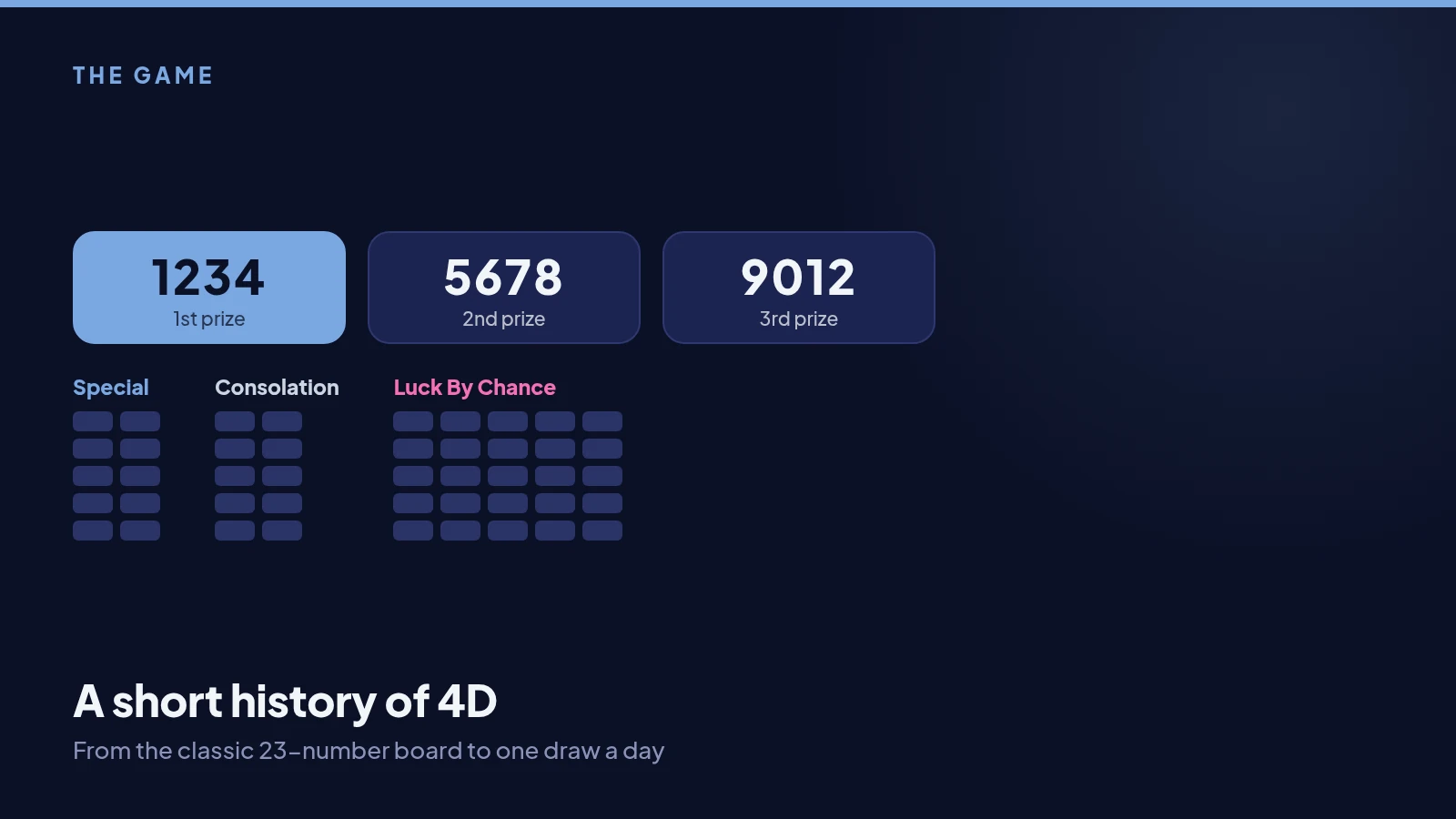
The traditional board has 23 winning numbers: first, second and third prize, ten Starter or Special prizes, and ten Consolation prizes. Draws traditionally run a few evenings a week. Players have always been able to play a number straight or cover its arrangements, which is where the Box and iBox tickets come from.
What fourdigits keeps
The heart of the game is unchanged: four digits, a Straight or a Box, a top row of three prizes and the Special and Consolation tiers underneath. Anybody who has played 4D before will recognise the board at a glance.
What fourdigits changes
There is one draw a day at a fixed time, 11:11 UTC, rather than a few a week. A fourth tier, Luck By Chance, adds 25 numbers, so every draw has 48 winners. Stakes and prizes are in dollar stablecoins, results are published the moment a draw settles, and the whole archive is free to search.